publications
(*) denotes equal contribution
2026
-
 Volumetric Ergodic ControlJueun Kwon, Max M. Sun, and Todd MurpheyIn IEEE International Conference on Robotics and Automation (ICRA), 2026.
Ergodic control synthesizes optimal coverage behaviors over spatial distributions for nonlinear systems. However, existing formulations model the robot as a non-volumetric point, but in practice a robot interacts with the environment through its body and sensors with physical volume. In this work, we introduce a new ergodic control formulation that optimizes spatial coverage using a volumetric state representation. Our method preserves the asymptotic coverage guarantees of ergodic control, adds minimal computational overhead for real-time control, and supports arbitrary sample-based volumetric models. We evaluate our method across search and manipulation tasks – with multiple robot dynamics and end-effector geometries or sensor models – and show that it improves coverage efficiency by more than a factor of two while maintaining a 100% task completion rate across all experiments, outperforming the standard ergodic control method. Finally, we demonstrate the effectiveness of our method on a robot arm performing mechanical erasing tasks.
2025
-
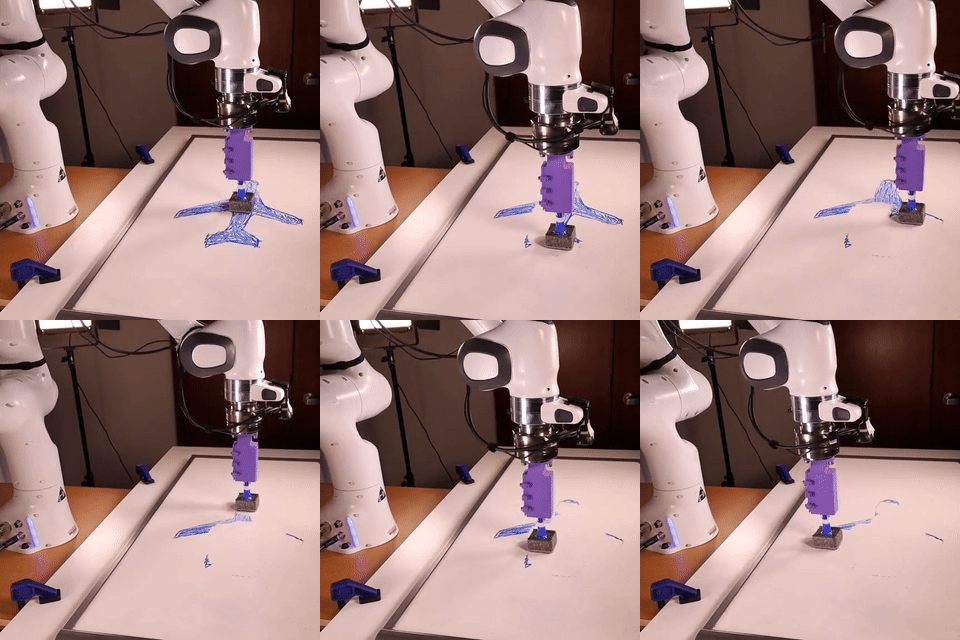 Flow Matching Ergodic CoverageMax Muchen Sun, Allison Pinosky, and Todd MurpheyIn Robotics: Science and Systems (RSS), 2025.
Ergodic coverage effectively generates exploratory behaviors for embodied agents by aligning the spatial distribution of the agent’s trajectory with a target distribution, where the difference between these two distributions is measured by the ergodic metric. However, existing ergodic coverage methods are constrained by the limited set of ergodic metrics available for control synthesis, fundamentally limiting their performance. In this work, we propose an alternative approach to ergodic coverage based on flow matching, a technique widely used in generative inference for efficient and scalable sampling. We formally derive the flow matching problem for ergodic coverage and show that it is equivalent to a linear quadratic regulator problem with a closed-form solution. Our formulation enables alternative ergodic metrics from generative inference that overcome the limitations of existing ones. These metrics were previously infeasible for control synthesis but can now be supported with no computational overhead. Specifically, flow matching with the Stein variational gradient flow enables control synthesis directly over the score function of the target distribution, improving robustness to the unnormalized distributions; on the other hand, flow matching with the Sinkhorn divergence flow enables an optimal transport-based ergodic metric, improving coverage performance on non-smooth distributions with irregular supports. We validate the improved performance and competitive computational efficiency of our method through comprehensive numerical benchmarks and across different nonlinear dynamics. We further demonstrate the practicality of our method through a series of drawing and erasing tasks on a Franka robot.
-
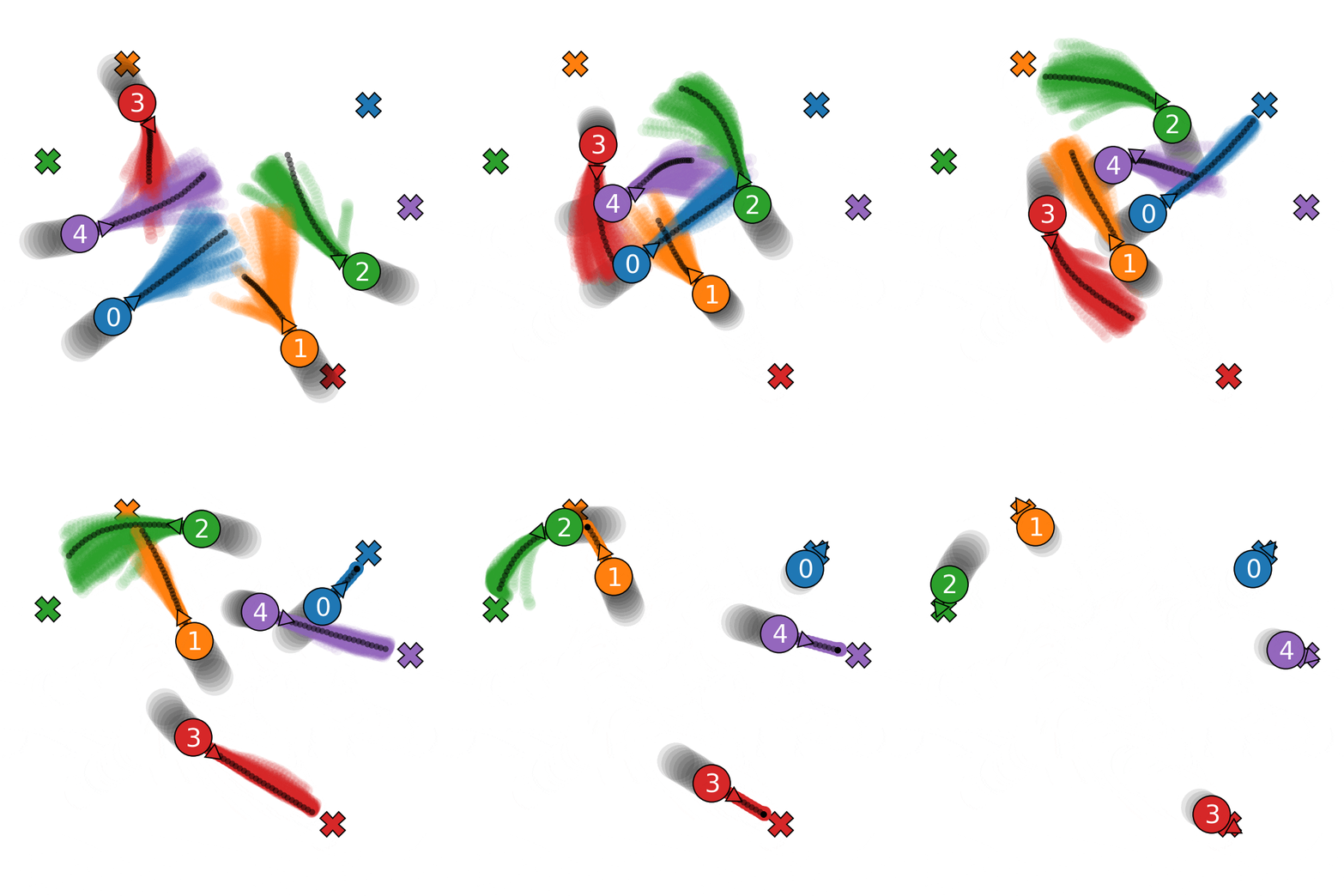 Inverse Mixed Strategy Games with Generative Trajectory ModelsMax Muchen Sun, Pete Trautman, and Todd MurpheyIn IEEE International Conference on Robotics and Automation (ICRA), 2025.
Game-theoretic models are effective tools for modeling multi-agent interactions, especially when robots need to coordinate with humans. However, applying these models requires inferring their specifications from observed behaviors—a challenging task known as the inverse game problem. Existing inverse game approaches often struggle to account for behavioral uncertainty and measurement noise, and leverage both offline and online data. To address these limitations, we propose an inverse game method that integrates a generative trajectory model into a differentiable mixed-strategy game framework. By representing the mixed strategy with a conditional variational autoencoder (CVAE), our method can infer high-dimensional, multi-modal behavior distributions from noisy measurements while adapting in real-time to new observations. We extensively evaluate our method in a simulated navigation benchmark, where the observations are generated by an unknown game model. Despite the model mismatch, our method can infer Nash-optimal actions comparable to those of the ground-truth model and the oracle inverse game baseline, even in the presence of uncertain agent objectives and noisy measurements.
-
 Fast Ergodic Search With Kernel FunctionsMax Muchen Sun, Ayush Gaggar, Pete Trautman and 1 more authorIEEE Transactions on Robotics (TRO), 2025.
Ergodic search enables optimal exploration of an information distribution with guaranteed asymptotic coverage of the search space. However, current methods typically have exponential computational complexity and are limited to Euclidean space. We introduce a computationally efficient ergodic search method. Our contributions are two-fold as follows: First, we develop a kernel-based ergodic metric, generalizing it from Euclidean space to Lie groups. We prove this metric is consistent with the exact ergodic metric and ensures linear complexity. Second, we derive an iterative optimal control algorithm for trajectory optimization with the kernel metric. Numerical benchmarks show our method is two orders of magnitude faster than the state-of-the-art method. Finally, we demonstrate the proposed algorithm with a peg-in-hole insertion task. We formulate the problem as a coverage task in the space of SE(3) and use a 30-s-long human demonstration as the prior distribution for ergodic coverage. Ergodicity guarantees the asymptotic solution of the peg-in-hole problem so long as the solution resides within the prior information distribution, which is seen in the 100% success rate.
2024
-
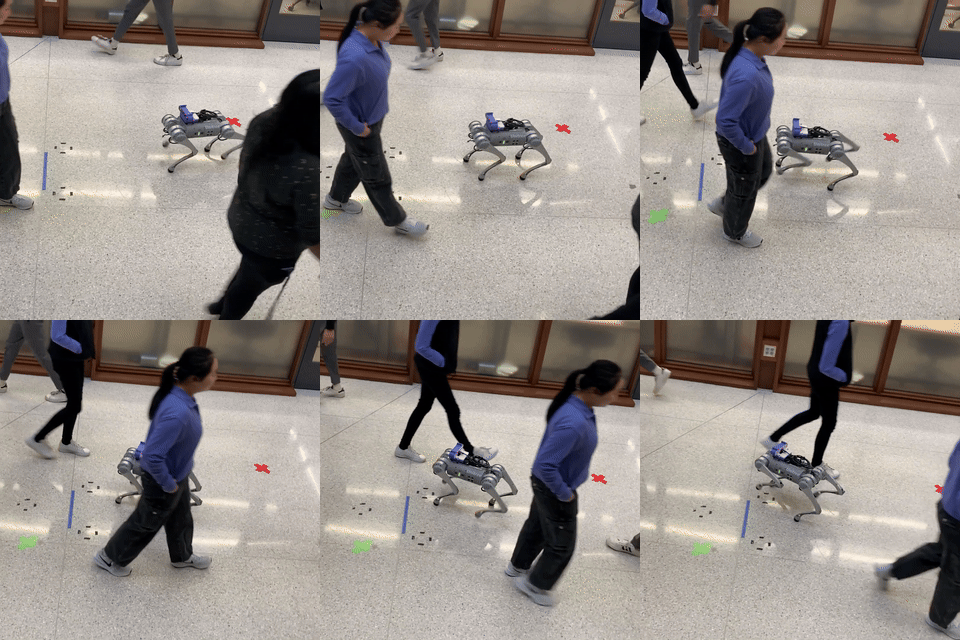 Mixed Strategy Nash Equilibrium for Crowd NavigationMax Muchen Sun, Francesca Baldini, Katie Hughes and 2 more authorsInternational Journal of Robotics Research (IJRR), 2024.
Robots navigating in crowded areas should negotiate free space with humans rather than fully controlling collision avoidance, as this can lead to freezing behavior. Game theory provides a framework for the robot to reason about potential cooperation from humans for collision avoidance during path planning. In particular, the mixed strategy Nash equilibrium captures the negotiation behavior under uncertainty, making it well suited for crowd navigation. However, computing the mixed strategy Nash equilibrium is often prohibitively expensive for real-time decision-making. In this paper, we propose an iterative Bayesian update scheme over probability distributions of trajectories. The algorithm simultaneously generates a stochastic plan for the robot and probabilistic predictions of other pedestrians’ paths. We prove that the proposed algorithm is equivalent to solving a mixed strategy game for crowd navigation, and the algorithm guarantees the recovery of the global Nash equilibrium of the game. We name our algorithm Bayesian Recursive Nash Equilibrium (BRNE) and develop a real-time model prediction crowd navigation framework. Since BRNE is not solving a general-purpose mixed strategy Nash equilibrium but a tailored formula specifically for crowd navigation, it can compute the solution in real-time on a low-power embedded computer. We evaluate BRNE in both simulated environments and real-world pedestrian datasets. BRNE consistently outperforms non-learning and learning-based methods regarding safety and navigation efficiency. It also reaches human-level crowd navigation performance in the pedestrian dataset benchmark. Lastly, we demonstrate the practicality of our algorithm with real humans on an untethered quadruped robot with fully onboard perception and computation.
2023
-
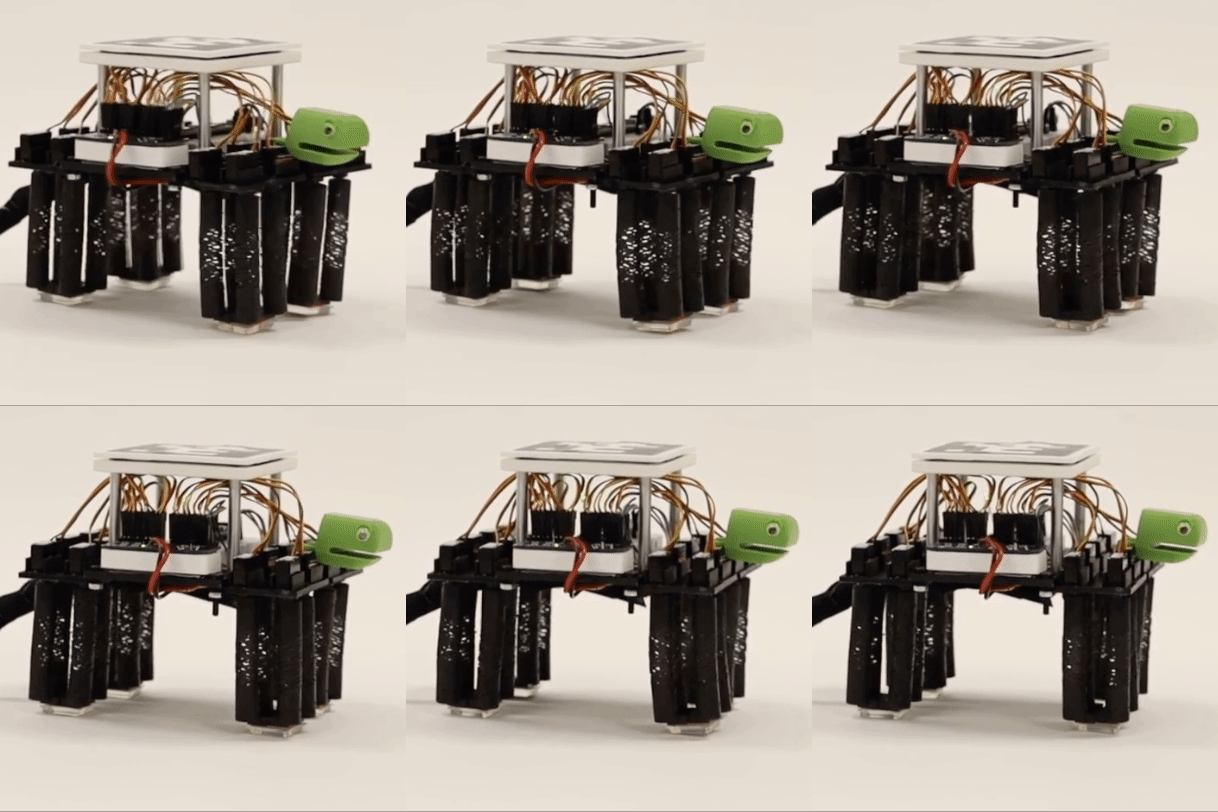 Automated Gait Generation for Walking, Soft Robotic QuadrupedsJake Ketchum, Sophia Schiffer, Muchen Sun and 3 more authorsIn IEEE International Conference on Intelligent Robots and Systems (IROS), 2023.
Gait generation for soft robots is challenging due to the nonlinear dynamics and high dimensional input spaces of soft actuators. Limitations in soft robotic control and perception force researchers to hand-craft open loop controllers for gait sequences, which is a non-trivial process. Moreover, short soft actuator lifespans and natural variations in actuator behavior limit machine learning techniques to settings that can be learned on the same time scales as robot deployment. Lastly, simulation is not always possible, due to heterogeneity and nonlinearity in soft robotic materials and their dynamics change due to wear. We present a sample-efficient, simulation free, method for self-generating soft robot gaits, using very minimal computation. This technique is demonstrated on a motorized soft robotic quadruped that walks using four legs constructed from 16 “handed shearing auxetic” (HSA) actuators. To manage the dimension of the search space, gaits are composed of two sequential sets of leg motions selected from 7 possible primitives. Pairs of primitives are executed on one leg at a time; we then select the best-performing pair to execute while moving on to subsequent legs. This method-which uses no simulation, sophisticated computation, or user input-consistently generates good translation and rotation gaits in as low as 4 minutes of hardware experimentation, outperforming hand-crafted gaits. This is the first demonstration of completely autonomous gait generation in a soft robot.
2022
-
 Scale-Invariant Fast Functional RegistrationMuchen Sun, Allison Pinosky, Ian Abraham and 1 more authorIn International Symposium of Robotics Research (ISRR), 2022.
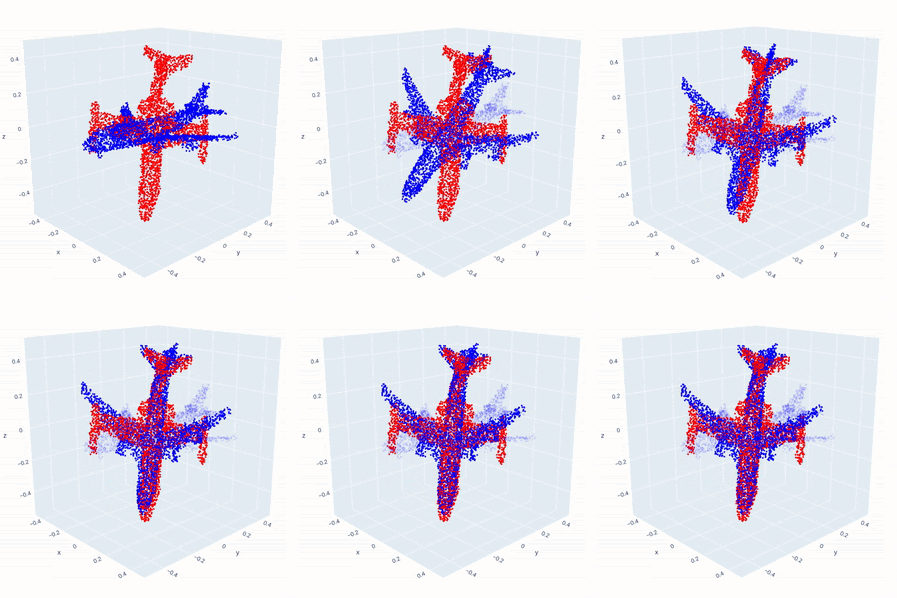
Functional registration algorithms represent point clouds as functions (e.g. spacial occupancy field) avoiding unreliable correspondence estimation in conventional least-squares registration algorithms. However, existing functional registration algorithms are computationally expensive. Furthermore, the capability of registration with unknown scale is necessary in tasks such as CAD model-based object localization, yet no such support exists in functional registration. In this work, we propose a scale-invariant, linear time complexity functional registration algorithm. We achieve linear time complexity through an efficient approximation of \Ł^2\\-distance between functions using orthonormal basis functions. The use of orthonormal basis functions leads to a formulation that is compatible with least-squares registration. Benefited from the least-square formulation, we use the theory of translation-rotation-invariant measurement to decouple scale estimation and therefore achieve scale-invariant registration. We evaluate the proposed algorithm, named \{}textsf{FLS}\\(functional least-squares), on standard 3D registration benchmarks, showing \{}textsf{FLS}\\is an order of magnitude faster than state-of-the-art functional registration algorithm without compromising accuracy and robustness. \{}textsf{FLS}\\also outperforms state-of-the-art correspondence-based least-squares registration algorithm on accuracy and robustness, with known and unknown scale. Finally, we demonstrate applying \{}textsf{FLS}\\to register point clouds with varying densities and partial overlaps, point clouds from different objects within the same category, and point clouds from real world objects with noisy RGB-D measurements.
2021
-
 Move Beyond Trajectories: Distribution Space Coupling for Crowd NavigationMuchen Sun, Francesca Baldini, Peter Trautman and 1 more authorIn Robotics: Science and Systems (RSS), 2021.
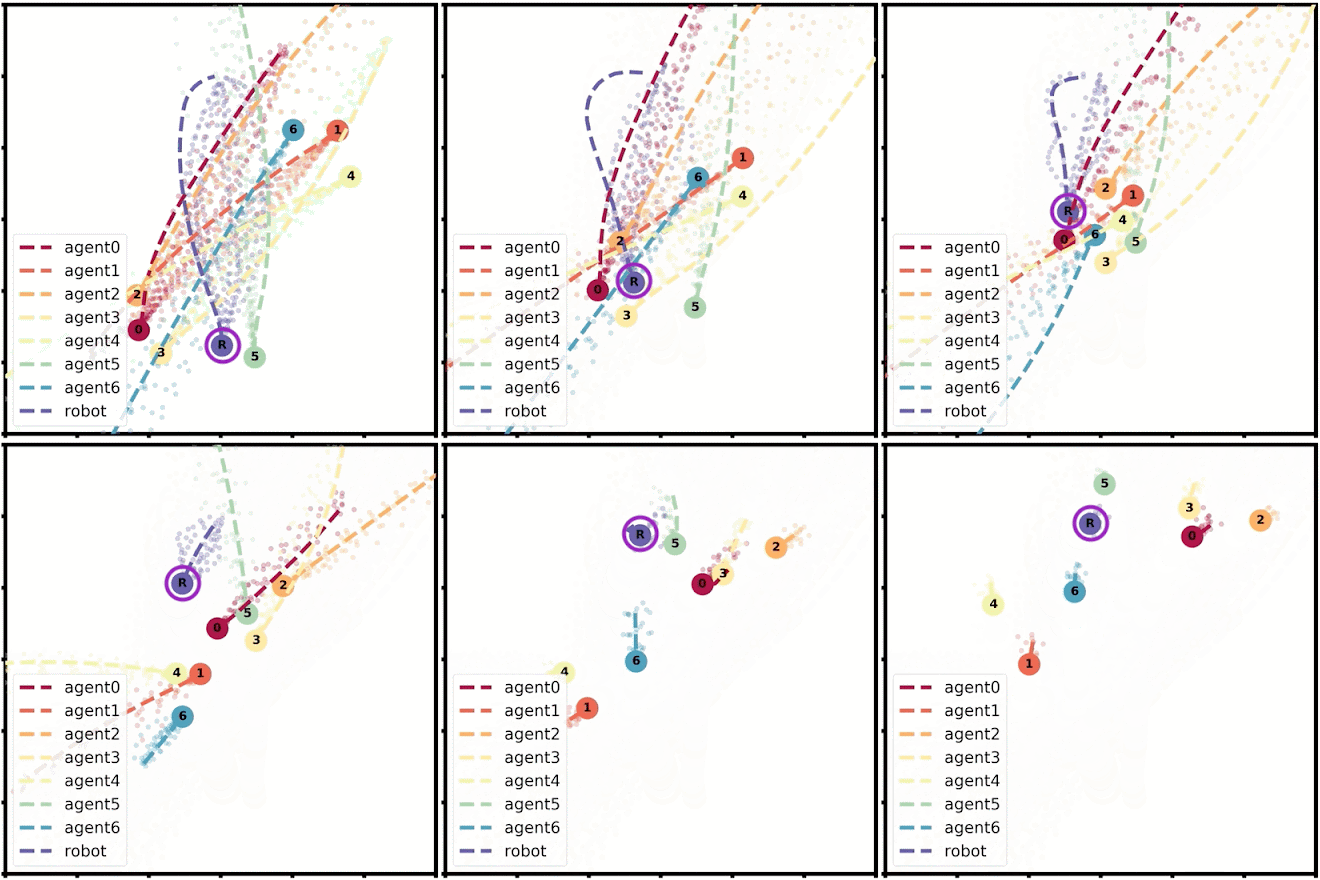
Cooperatively avoiding collision is a critical functionality for robots navigating in dense human crowds, failure of which could lead to either overaggressive or overcautious behavior. A necessary condition for cooperative collision avoidance is to couple the prediction of the agents’ trajectories with the planning of the robot’s trajectory. However, it is unclear that trajectory based cooperative collision avoidance captures the correct agent attributes. In this work we migrate from trajectory based coupling to a formalism that couples agent preference distributions. In particular, we show that preference distributions (probability density functions representing agents’ intentions) can capture higher order statistics of agent behaviors, such as willingness to cooperate. Thus, coupling in distribution space exploits more information about inter-agent cooperation than coupling in trajectory space. We thus introduce a general objective for coupled prediction and planning in distribution space, and propose an iterative best response optimization method based on variational analysis with guaranteed sufficient decrease. Based on this analysis, we develop a sampling-based motion planning framework called DistNav1 that runs in real time on a laptop CPU. We evaluate our approach on challenging scenarios from both real world datasets and simulation environments, and benchmark against a wide variety of model based and machine learning based approaches. The safety and efficiency statistics of our approach outperform all other models. Finally, we find that DistNav is competitive with human safety and efficiency performance.